
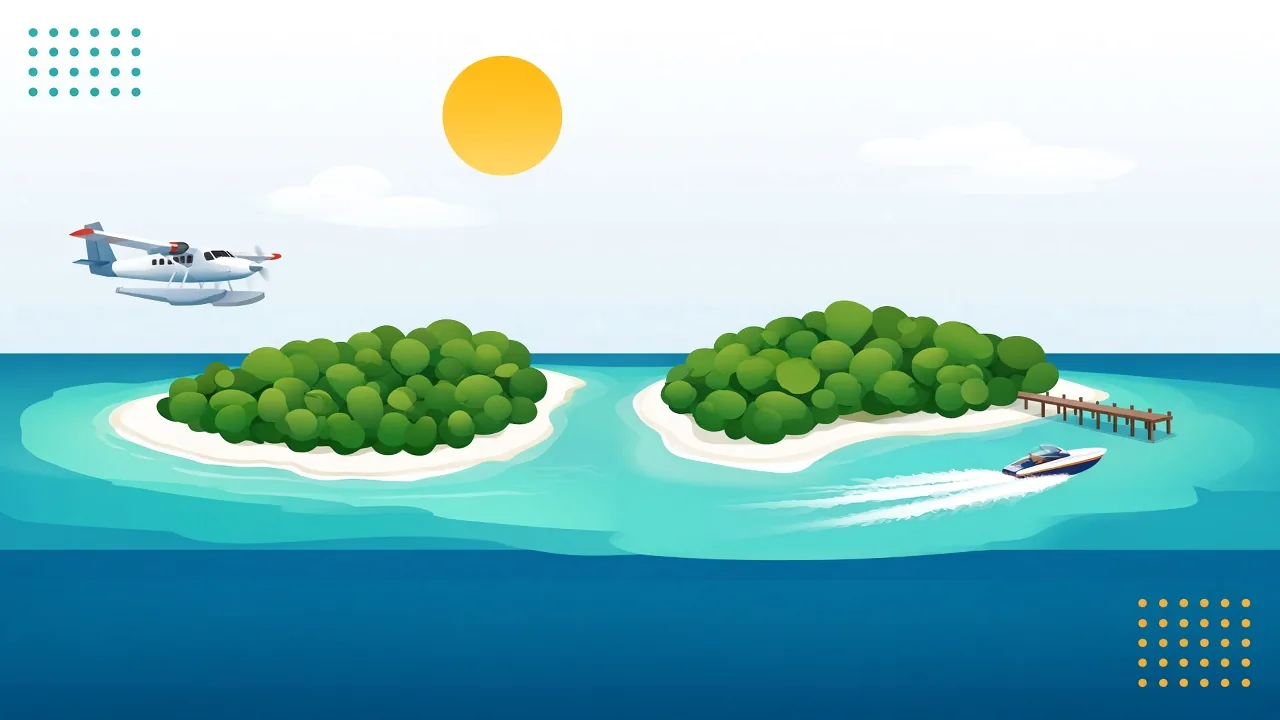
When you land at Velana International Airport (MLE), there is one more journey before you reach your island. For most visitors that transfer is a seaplane or a speedboat, and many itineraries also include a domestic flight, a public ferry or a short boat ride from a regional airport. There are no roads between the atolls, so every island is reached by sea or by air. The right choice depends on how far your island is from Malé, whether you are staying at a resort or a guesthouse, whether you land in daylight, how comfortable you are on open water and how much time you leave around your international flights.
| Seaplane | A scenic seaplane flight leaves from the seaplane terminal near Malé. It usually serves the farther resorts and flies only in daylight. |
|---|---|
| Speedboat | A speedboat takes you straight from the airport jetty. It is the usual choice for islands near Malé and many local island guesthouses, and it runs over longer hours than a seaplane. |
| Public ferry | Public ferries, many of them run by MTCC, link the inhabited islands. They are slower and cheaper than a speedboat and suit guesthouse travellers hopping between local islands. They do not serve private resorts. |
| Domestic flight | Domestic flights go from Velana to regional airports such as Gan, Hanimaadhoo, Kooddoo and Kaadedhdhoo. A shorter speedboat or hotel boat usually completes the journey. |
| Resorts and guesthouses | Resorts usually arrange a private or scheduled seaplane or speedboat. Guesthouses more often use the public ferry, a shared speedboat or a hotel boat from Malé. |
| Seaplane hours | Seaplanes generally stop flying in the late afternoon, and the last departures change with the season and the weather. If you land late, you will often need a night in Malé. |
| Journey times | Speedboat rides often take anywhere from 15 minutes to an hour and a half or more. Seaplane flights usually last 20 to 60 minutes, and longer ferry trips can take several hours. Treat all of these as rough guides. |
| Luggage | A duffel bag or other soft luggage is much easier to fit into a seaplane than a hard case. Seaplanes have strict weight and bag limits, so check yours before you travel. |
| Weather | Wind, showers and rough seas affect boats, ferries and seaplanes. Delays and choppy crossings are more likely from May to October, and our season guide explains why. |
| Who usually flies by seaplane | Many resorts in the farther atolls are too far from Malé for a practical speedboat ride, so their guests arrive by seaplane. |
| Who usually travels by boat | Guests at resorts near Malé usually travel by speedboat. Many guesthouses on local islands use a speedboat, a shared boat or the public ferry. |
| What this guide covers | Read on for each type of transfer, including ferries and domestic flights. The guide also covers resort and guesthouse transfers, seaplane hours, luggage, families, overnight stops in Malé and how to choose. |
What is a Maldives seaplane transfer?

A seaplane transfer is a short flight in a floatplane from the seaplane terminal near Malé to a landing in the lagoon or by the reef beside your island. Trans Maldivian Airways is the best-known operator for holiday flights. Once you clear arrivals, you go to the seaplane lounge to check in, have your bags weighed and wait for your shared or scheduled departure.
What the flight is usually like
- The plane flies low over atolls, sandbanks and coral reefs, and for many guests it is one of the highlights of the holiday.
- On many days the flight is shared, and the plane may land at other resorts before yours. The published flight time is only a guide.
- After landing in the lagoon or by the reef, you take a short boat ride or walk along a jetty onto the island.
Seaplanes come into their own when an island is too far for a comfortable speedboat ride from Malé. For many resorts, the location of the island decides the transfer, and the seaplane is the only standard option.
What is a Maldives speedboat transfer?

A speedboat transfer is a fast boat, either covered or open, that takes you from the airport jetty to your resort or local island guesthouse. Speedboats serve much of North and South Malé Atoll (Kaafu) and the islands nearby. Some farther islands still use long boat rides, but the journey becomes less comfortable the longer you spend crossing open channels.
What to know about speedboats
- Speedboats keep longer hours than seaplanes. Evening and early morning boats are often possible if the operator can run them and the sea is calm enough.
- You board at the airport jetty and step off at your island, with no seaplane lounge in between.
- The boat moves more and throws up more spray on windy or choppy days. If you get seasick, sit near the middle of the boat, and keep your documents in a waterproof pouch.
- Many local island guesthouses near Malé are reached by boat. Our local island guesthouses vs resorts guide explains how the two kinds of stay compare.
What about public ferries between local islands?
The Maldives also has a public ferry network, run largely by MTCC and related services, that links many inhabited islands. These boats are everyday transport for island communities, and they do not call at private resorts. Ferries are slower and cheaper than a private speedboat, and timetables can change because of weather, maintenance or demand.
Who the public ferry suits
- Guesthouse travellers can use it to hop between local islands on a flexible itinerary.
- If your island already has a ferry service, a scheduled boat saves booking a private speedboat for every trip.
- It works well for anyone relaxed about waiting between sailings, since a ferry runs more like a local bus than an airport pickup.
Who the public ferry usually does not suit
- Most resort guests will not use it. Private resort islands have no public ferry stop, so you travel by seaplane, speedboat, or domestic flight and boat, arranged with the resort.
- It is a poor fit for a tight same-day connection after a late international arrival, when you need a boat waiting for you at a set time.
- It cannot take you to a resort island reached only by seaplane, because the ferries do not go there.
Public ferries are a good way to travel between local islands at your own pace. Check the current timetable before you plan a same-day international connection around a ferry sailing.
When do domestic flights make sense?
For many trips to the southern and more distant atolls, the practical route is a domestic flight from Velana (MLE) to a regional airport, followed by a shorter speedboat or hotel boat to the island. Common gateways include Gan in Addu Atoll, Hanimaadhoo in the north, and southern airports such as Kooddoo and Kaadedhdhoo. Always check which airport your island’s published transfer uses.
A domestic flight makes sense when:
- Your island is usually reached by a domestic flight and a boat, which saves a long seaplane flight from Malé.
- A direct boat from Malé would be uncomfortably long, or is not offered as the usual route.
- You land after the seaplanes have stopped for the day and would rather take an early domestic flight the next morning, followed by a short boat ride.
- You want a week in a farther atoll where the resort’s published transfer is a domestic flight and a boat. Our Meemu Atoll family guide has examples of resorts with plenty of space for families.
What the journey is usually like
- You check in for the domestic flight at Velana, separately from the seaplane lounge, and then fly to the regional airport.
- Luggage rules are closer to those of an ordinary airline than a seaplane, but you should still check the allowance for your dates.
- The last leg is a short boat ride from the regional jetty or harbour, and it is often the calmest water of the day.
Book a domestic flight only when it matches the transfer your island actually uses. When it does, a domestic flight and a short boat ride are often easier than a very long boat journey, and they can reach islands that seaplanes do not serve.
How do resort transfers differ from guesthouse transfers?
Resort transfers are usually arranged as part of your stay. The resort, or the company it works with, organises a scheduled or private seaplane, a speedboat, or a domestic flight and boat. It tells you in advance where to meet, whether your bags will be weighed and what time you leave.
Guesthouse transfers on local islands more often use the public ferry, a shared speedboat or a boat arranged by the hotel from Malé or a nearby harbour. Arriving feels more like joining the island’s everyday boat traffic than landing in a private lagoon, and the timing often depends on the boat schedule.
How arrival day differs
- At a resort, you usually have one main transfer, arranged in advance with the resort’s partner, that takes you all the way from the airport to the island.
- At a guesthouse, you can choose between the ferry, a shared boat and a private boat. You will need to check schedules more carefully, and sometimes you first make a short hop to a harbour in Malé.
- Remote resorts still depend on seaplane hours, while many guesthouses near Malé can be reached by boat after dark when the sea is calm.
For more on the two kinds of stay, read our local island guesthouses vs resorts guide. This guide concentrates on how you get there.
Why do seaplanes stop at dusk?
Holiday seaplanes in the Maldives fly only in daylight, because pilots need to see clearly to land on lagoons and near reefs. As the light fades, usually in the late afternoon at a time that shifts through the year, scheduled seaplane flights stop. The exact last departure depends on the operator and the weather, so use mid to late afternoon as a rough guide when you plan.
What this means for your flight booking
- If you land in the late evening or at night, you will often spend a night in Malé or Hulhumalé and take the next daylight seaplane.
- A tight same-day connection can easily fall apart if your long-haul flight is delayed, even in the dry months.
- Leave extra time when showers or wind are likely. The section on weather below explains more.
If your island is reached only by seaplane, choose an international flight that lands in daylight, or plan a night near the airport as part of the trip.
How do luggage, soft bags, and weight rules work?
Seaplane holds are smaller than those on a jet, and the shape of your bag matters. Operators publish weight allowances and sometimes limits on the number of bags, and resorts send these details to guests before they travel. Duffel bags and other soft luggage fit into awkward spaces far more easily than rigid wheeled suitcases. Dive gear, golf bags and large hard cases may need to be arranged in advance.
Habits that make transfer day easier
- Pack in soft bags if your trip includes a seaplane.
- Weigh your bags at home and compare them with the allowance your resort or operator confirms.
- Keep passports, medicines and a change of clothes in a small bag you can carry with you through the seaplane lounge.
- On speedboats and ferries, a waterproof phone pouch and a light jacket help when the spray picks up.
Always follow the weight and bag limits confirmed for your dates. Domestic flights usually have luggage rules closer to those of an ordinary airline, but check ahead if you are bringing anything oversized.
How do weather and season affect transfers?
Boats, ferries and seaplanes are all affected by the monsoon. The drier northeast monsoon, roughly November to April, often brings calmer seas and clearer skies for flying. The wetter southwest monsoon, roughly May to October, brings more showers and wind. Seaplanes are more likely to wait on the ground when visibility drops, and boats have a rougher ride through exposed channels.
Planning tips for the season
- When showers are likely, avoid pairing an overnight flight that lands early with a long seaplane transfer the same morning.
- Treat published journey times and ferry timetables as guides, because weather and extra stops can change the day.
- Before you book long-haul flights, ask whether your island is usually reached by speedboat, seaplane, ferry, or a domestic flight and boat.
Our guide Best Time to Visit the Maldives by Season explains the seasons in more detail. German travellers heading out in the wetter months can read the Maldives May to October guide for German travellers, and Russian travellers planning a trip in the winter peak will find the season and transfers covered in the Maldives winter season and transfers guide for Russian travellers.
Who usually needs a seaplane, and who can go by speedboat?
Seaplane guests usually stay at resorts in the farther atolls, where a direct boat from Malé would be long or rough, or is not the standard route. The more remote the resort, the more likely it is that you will arrive by seaplane.
Speedboat guests usually stay closer to Malé, at one of the many resorts in Kaafu Atoll or on a local island with guesthouses. A shorter time on the water suits first-time visitors, families with young children and anyone arriving on a late flight.
Distance is only part of the picture. Some islands are close to a domestic airport, and others sit on a reliable boat or ferry route. Check the standard transfer for your exact hotel, because its position on the map can be misleading.
Should you plan a night in Malé before your transfer?
A night in Malé or Hulhumalé can make the whole trip smoother. It helps when:
- Your long-haul flight lands after the seaplanes usually stop for the day.
- Your connection is tight, and a single delay would make you miss the last seaplane.
- You are travelling with babies, elderly parents or anyone who needs a rest before the next part of the journey.
- Wet season showers make same-day seaplane connections less predictable.
An overnight stop lets you clear immigration without rushing and start the island journey fresh. For entry rules and when to complete the IMUGA traveller declaration, see our Maldives entry requirements and visa guide.
What should families prioritise when choosing a transfer?
For families, a simple journey with some spare time built in usually matters more than a scenic flight.
- With babies or toddlers, a short ride after the long flight, or a speedboat that can run in the evening, is often kinder than a long seaplane transfer straight after an overnight flight.
- If your dream island is reached only by seaplane, plan a night in Malé and pack soft bags so check-in and weighing go smoothly.
- Children who get seasick may do better on a morning boat on a calm day. Bring snacks, water and a light layer.
- Long public ferry trips rarely suit tired children on arrival day. Save ferry hops for later in a guesthouse stay, once everyone has settled in.
- Leave some spare time so a weather delay does not cost you your first afternoon on the beach.
That is why many families on their first Maldives holiday stay near Malé and save the farther atolls for a later trip.
How do you choose the right transfer?
Work through these questions in turn.
- Island location. What is the standard transfer for your exact hotel?
- Type of stay. Are you staying at a resort, which will arrange a seaplane, speedboat or domestic flight, or at a guesthouse, where the ferry, a shared boat or a hotel boat is more likely?
- Arrival time. Does your international flight land in time for a daylight seaplane, or do you need a boat that runs later or a night in Malé?
- Comfort at sea. How well do you and the rest of your group cope with choppy water?
- Luggage. Can you pack in soft bags within the seaplane weight limits, and have you told your hotel about any oversized gear?
- Season. The dry months are often calmer. In the wetter months, allow more time around seaplane connections and ferry crossings in exposed channels.
- Style of trip. Islands near Malé and many Kaafu resorts are reached by boat. Remote resorts usually use a seaplane or a domestic flight and boat, and a guesthouse week across several islands may use the ferry.
Once you have these answers, the right transfer usually becomes clear. A scenic flight is a lovely bonus, but there is little point flying to an island that is a short boat ride away, and a ferry cannot take you to a private resort that only receives seaplanes.
FAQ
Can I choose between a seaplane and a speedboat for any island?
Usually you cannot. Most hotels have a standard transfer, decided by distance, the reef around the island and how the resort operates. Some islands offer more than one option, but many do not.
Can I take a public ferry to a resort?
Generally no. Public ferries serve inhabited local islands. Private resorts use a seaplane, a speedboat, or a domestic flight and boat, arranged with the resort.
What happens if my flight lands after the seaplanes stop?
You will usually stay overnight near Malé and take the next daylight seaplane. The exceptions are islands that a speedboat can reach at that hour, and islands reached by a domestic flight and boat, which you can take the following morning.
Are seaplane times exact?
Treat them as a guide. Shared flights and weather delays can change both departure and arrival times.
Do speedboats and ferries run in the rain?
Often they do, as long as the sea stays calm enough, but operators may delay or reschedule trips when the channels are rough. Pack a light waterproof jacket and expect some spray.
Is a seaplane safe in the wet season?
Operators fly when conditions are suitable and wait when they are not. In the wet season you may face more delays or need a night in Malé, although flights still run whenever the weather allows.
Should I bring hard-shell luggage?
For seaplanes, soft bags are the easier choice. If you need to bring a hard case, check its size and weight against the limits the operator gives you for your dates.
How early should I think about transfers?
Think about them before you book non-refundable long-haul flights, especially if your resort is reached only by seaplane or you are travelling in the busy festive season.
Ready to enquire?
Tell us your rough dates, the kind of island you have in mind and what time your flight lands, and we will help you plan transfers that suit your trip.
Enquire: aviholidays.com/inquiry/
WhatsApp: +9609696941 or +9609842232
Email: [email protected]
Last updated: 27 Sep 2026.